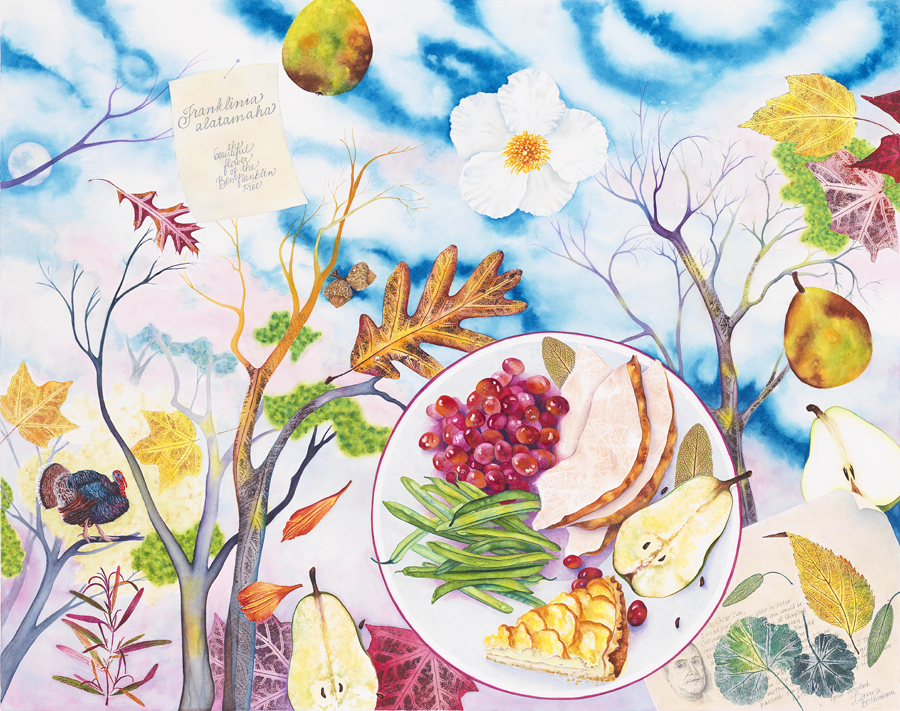
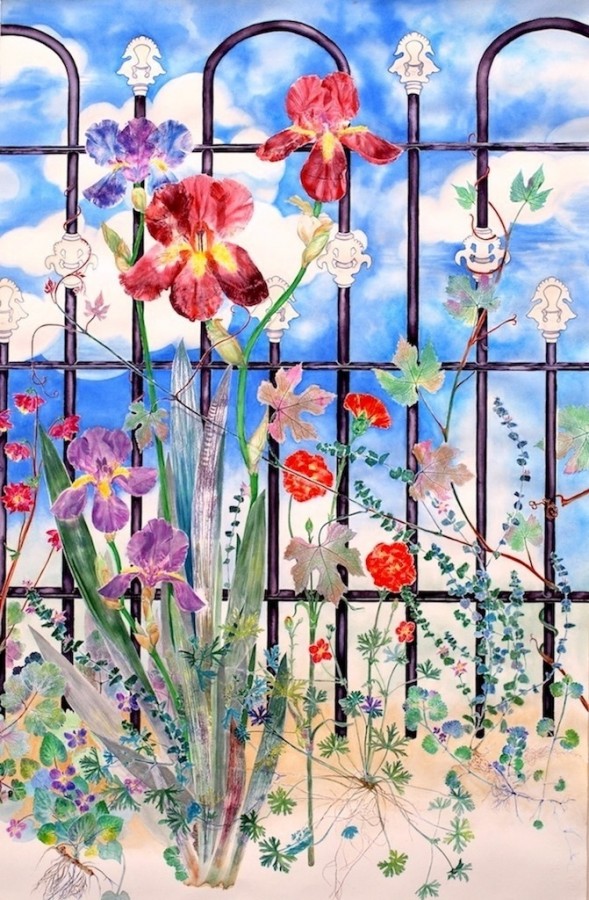
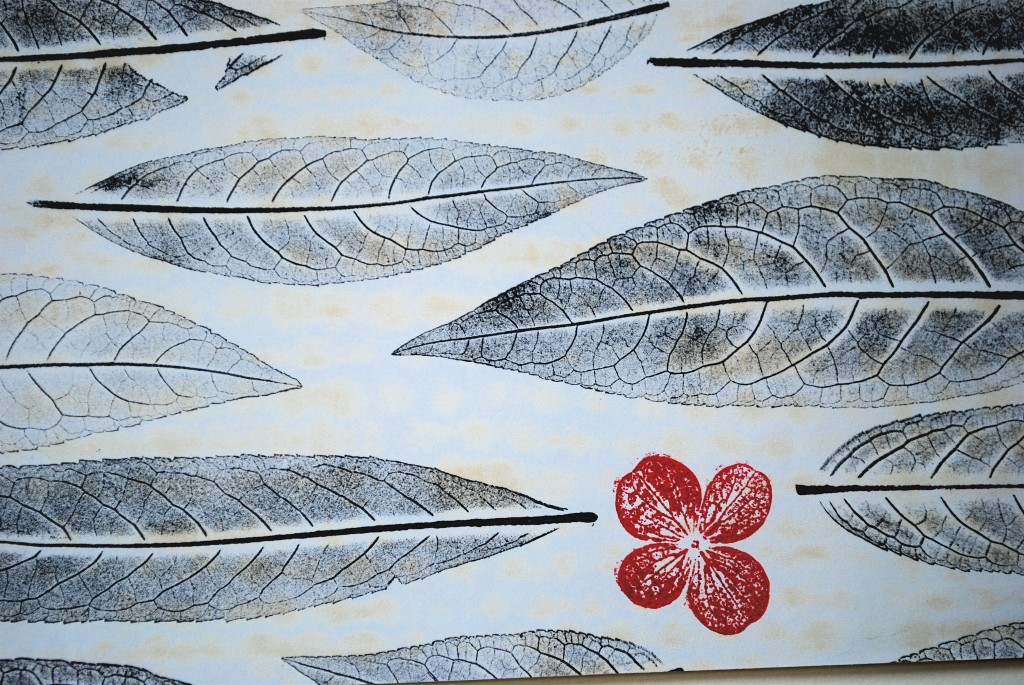
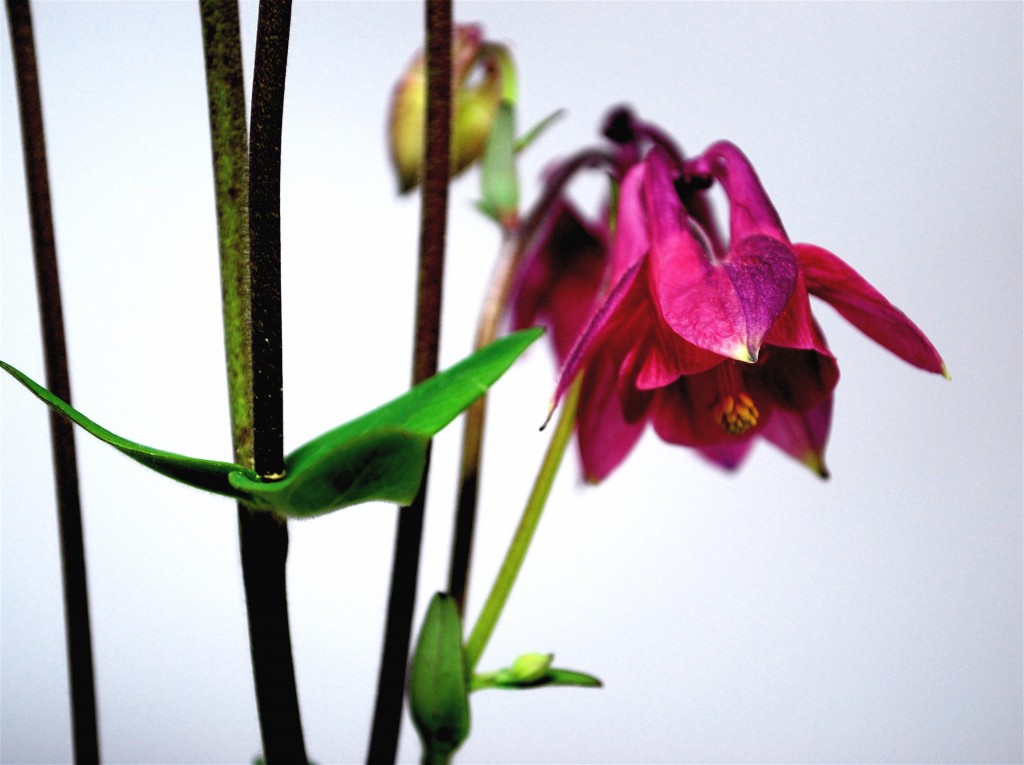
Dear Ben is a nature print painting in my ongoing Invitation Series. Each painting is an ‘invitation’ to an historical hero of mine. This invitation is to Benjamin Franklin.
To get to know someone we might invite them to dinner, or breakfast, or tea. The invitations in this series are to some of my favorite, exceptionally accomplished people – whom I will never get to meet. They are alive only in our imaginations through their work, their words, and what others have said or shown about them.
I accept the fact that it is easier to want to get to know ‘the real’ person when it’s not likely to happen. No one is perfect, not even our heroes, so meeting them can be a disappointment as we discover even normal human flaws in their scruples, relationships, or misdeeds. It’s easy to aggrandize the people we admire. It’s best to remember that we’re all mere mortals, subject to faults and weaknesses.
That said, Ben had a lot going for him. He was the most accomplished person of his era. A founding father, scientist, inventor, writer, publisher, printer, political theorist, postmaster and diplomat. As a civic activist Ben began the first fire department, hospital, library and university in America. He printed colonial currency using nature prints!
This invitation nature print painting is based on a letter he wrote to Peter Collinson describing his plan to invite friends to a gathering near the Schuylkill River in Philadelphia. Among various entertainments involving electricity, he planned to electrocute a turkey then roast it over electric fire.
I forgot to mention, Ben was also a great prankster.
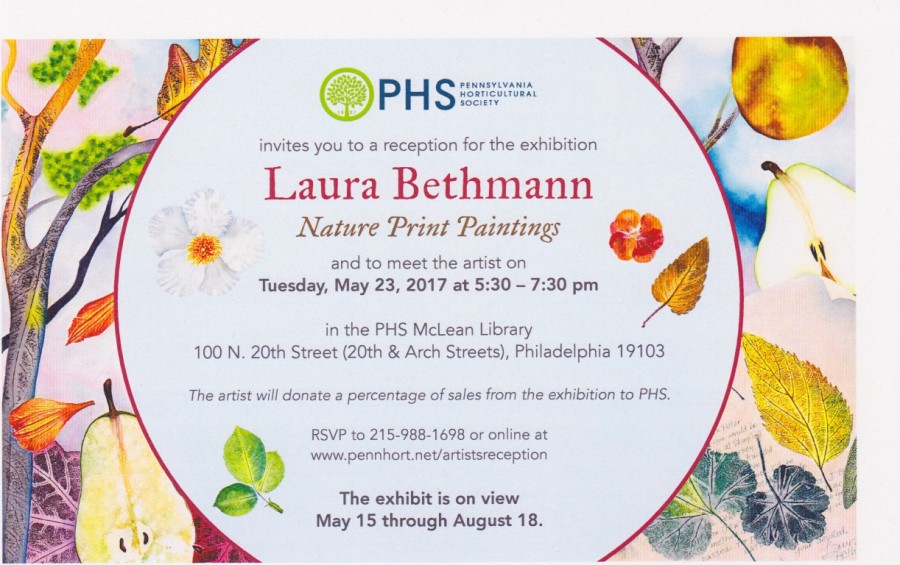
Hope to see you at the reception for an exhibit of my recent nature print paintings. The McLean Library of the Pennsylvania Horticultural Society has a beautiful, bright gallery space on the ground floor in their downtown Philadelphia offices.
Come see my ongoing Invitation Series! On exhibit are nature print painting ‘invitations’ to Ben Franklin, John Bartram, Beatrix Potter, Maria Sibylla Merian and Georgia O’Keeffe, along with many smaller nature print paintings. Remember to sign the little book set up near the exhibit and tell me – if you could meet anyone from history, who would it be?!
Spring is so close I can feel it in my bones. I’m envisioning sprouting grape hyacinths, daffodils and peonies, greening herbs and rose buds. I can’t wait to get going in the garden, clearing up winter’s straggly leftovers, digging and planting . . . and sketching, painting and nature printing my rewards.
Meanwhile, I get to go to the largest indoor flower show in the world, practically on my doorstep – the Philadelphia Flower Show. People come from all over the world to visit, and to participate. There’s so much to see and do. Amazing exhibits, classes, garden related vendors, much more than I can list here (check the link below). The dates are March 5-13, 2016. This year’s theme is Explore America: 100 Years of the National Park Service.
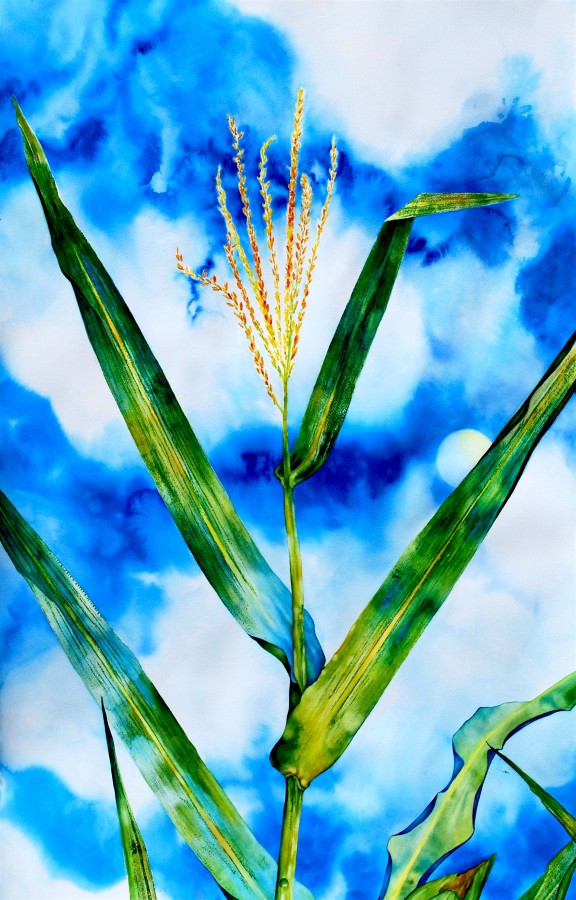
Detail: Corn in Bloom, watercolor and nature print by Laura Bethmann
Art is subjective, we choose what we like. I like this painting. I like the tall, dramatic corn growing up into the bright sky. But I made it, so I know what I like about it.
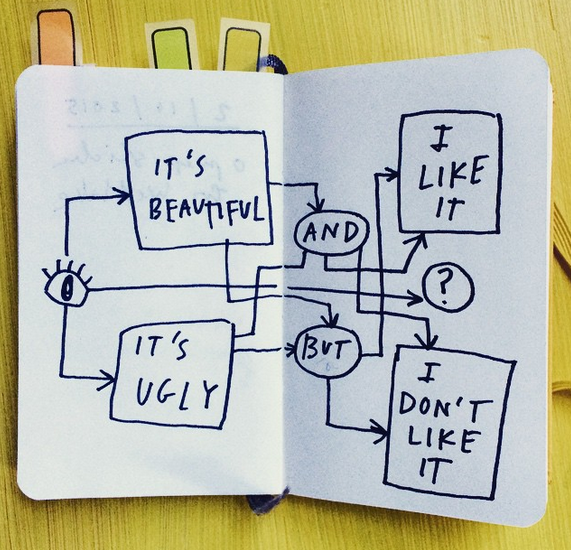
Drawing by Austin Kleon, author of Steal Like An Artist www.austinkleon.com
What makes us distinguish between likable or not likable, beautiful or ugly, good or bad?
In 2012, the Huffington Post reported on an episode of the PBS program Antiques Roadshow. A man brought in two paintings which he purchased for $2.50 each. He liked one painting but thought the other one was ugly. Turns out that the ‘ugly’ one, by American artist Willaim Victor Higgins (apologies to Mr. Higgins) was appraised for $75,000 to $100,000. The one he liked didn’t have much monetary worth at all. Beautiful and ugly can be at odds when it comes to personal taste, not to mention cash value! (Why he bothered to buy what he considered to be an ugly painting wasn’t explained, but in the end you can bet he was glad he did.)
Our sociological patterns of choice and preference refer to how we view and adapt to styles, manners, and all kinds of things – including works of art. Our individual tastes are influenced by many factors, but we know what we like.
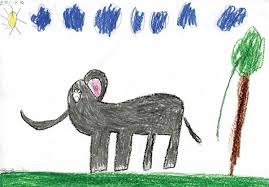
We all love the wonderful, brilliant paintings created by our 5-year-olds. I love everything the Beatles have done – been a fan for 50 years. I took a quick survey from some of my near and dear. Husband Chris loves the paintings of Johannes Vermeer. Nephew Steve loves Tool and van Gogh. Daughter Cara goes crazy for Bernini, Caravaggio and post-impressionist landscapes. Son-in-law James is enthralled with jazz artist Sonny Rollins and metal bands. Bunny is enchanted by Puccini. Rosemary chooses Verdi, Springsteen, Gothic architecture, Shakespeare and wants to know if France and flowering trees can be considered art forms. Peter weighs in with more metal bands and JMW Turner. Doug’s picks are John Singer Sargent and the pre-Raphaelites. There were more lists, and longer, but you get the idea. This was eye-opening for me!
Make a list of your favorite artists then take a survey of your own. You’ll learn a lot about your people!
We also know what we don’t like, but it’s important to remember that we are judging through a lens of personal preference – our personal taste. Even when we aren’t warming up to a painting, a song, a poem, or whatever it is, we can often appreciate art for it’s own inherent, redeeming qualities.
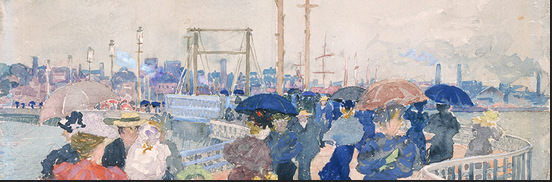
Maurice Prendergast watercolor paintings make me happy
Long ago I laid eyes on the watercolor paintings of Paul Cezanne and have been in awe ever since. His watercolors have proved a huge influence for me (thank you, Monsieur Cezanne). And even though I’m not enamored of his oil paintings, I realize that Cezanne was the father of modern art, a breakthrough genius, and I certainly appreciate his vision.
I’m not fond of Led Zeppelin’s music (my regrets LZ fans) but their talent is obvious. ‘Stairway to Heaven’ – yes, I get it.
And so, rather than discounting any work of art entirely, it’s possible to stretch the imagination and come to realize it’s intrinsic value. Of Led Zeppelin’s music I might say:
That song makes my heart feel like it’s beating the wrong way, but it’s because of the band’s phenomenal rhythmic patterns.
Of another artist that proves difficult for me:
It hurts to look at some of Francisco Goya’s paintings, like Satan Devouring His Son and A Pilgrimage To San Isidro. They’re really disturbing, but Goya’s talent is amazing.
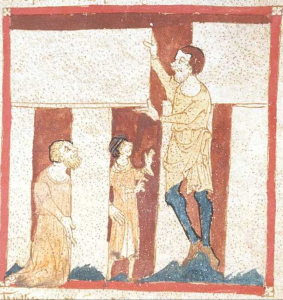
I love Stonehenge. Those who don’t might consider that even though…
Stonehenge is just a bunch of stones, and some are broken or missing, no one knows how this 5000 year old earth work was erected, or how 50 ton rocks were transported over 200 miles to build it, or for what purpose. Modern-day experts have theorized about it for hundreds of years. It’s an astounding neolithic mystery and a tribute to the people who created it.
The important thing is, we can appreciate even what we don’t like.
A giant helps Merlin build Stonehenge. From a 14th century manuscript in the British Library. Roman de Brut verse of literary history, by Norman poet Wace
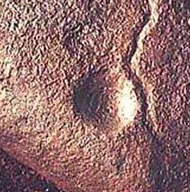
Cupule detail at Auditorium Cave at Bhimbetka, Madhya Pradesh, India. Dates from 290,000 – 700,000 BCE
Early humans, homo-erectus, were creating cupules (a type of rock carving) hundreds of thousands of years ago.
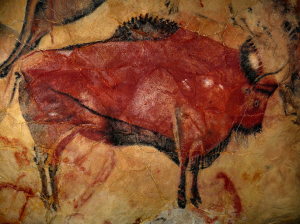
15,000 to 40,0000 years ago, humans were creating expressive paintings of animals, hand prints and markings on cave walls in what is now France and Spain.
Bison in the Cave of Altamira, Spain. Paintings date from approximately 20,000 years ago.
Art is a very big subject. It’s up there with the likes of philosophy, science and history (quite recent subjects compared to art).
If you’ve ever drawn so much as a stick figure, jotted a poem, danced a few steps or hummed a tune you’re part of the story.
It has always been in our nature to make art and here’s why:
Art reveals our ideas, emotions and experiences.
Art tells our stories. It’s a form of communication, a union among people.
Art is about who we are as a creative species.
As long as I’m breathing I’ll keep painting, printing and drawing. Because it’s important.
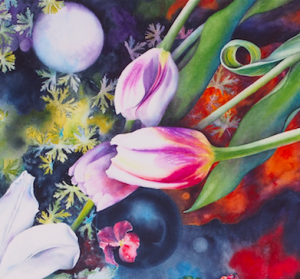
detail: Garden Path.Tulips, watercolor, Laura Bethmann
What’s your favorite go-to form of expression? How do you bring art into your life?
Almost every day, in all kinds of weather, Andy Goldsworthy goes outside and makes art.
Nature provides the materials. He works with what he finds – leaves, flowers, twigs, branches, rocks, stones, clay, mud, water, ice, snow, feathers… The artwork lives where the materials are found. When the delicate tension and balance are upset by a breeze, he begins again. When a long chain of leaves held together by thorns is placed in a stream, it’s carried off weaving its way along the current. All of his sculptures and assemblages are subject to the elements. He says of his work that it grows, stays and decays. Process and decay are implicit.
His tools are his hands and maybe a sharp stone or other found implement. Goldsworthy’s land and installation art are captured in photos and on film. Watch this great video, produced by wwvelasca, https://www.youtube.com/watch?v=hF-Mgx2aSC8#action=share
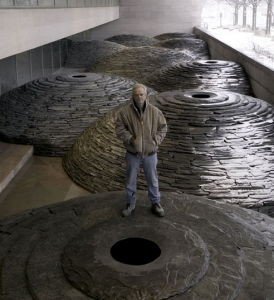
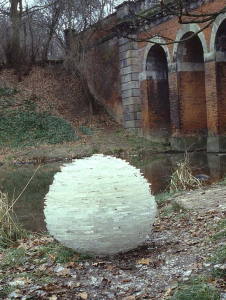
“Roof” Andy Goldsworthy. February, 2005. Photo by Lee Ewing. National Gallery of Art.“Ice Ball” Hampstead Heath, London. December 1985. Andy Goldsworthy.
Creating a garden or creating artwork? Great advice, which can be applied to both, come from Gertrude Jekyll’s ‘A Gardening Credo’. An excellent gardener and a fine writer, Gertrude learned by doing… and she did a lot! Born in London in 1843, Gertrude designed about 400 gardens in England, Europe and America, and was also a painter and photographer.
The real way is to try and learn a little from everybody and from everyplace…It is no use asking me or anyone else how to dig…Better go and watch a man digging, and then take a spade and try to do it, and go on trying till it comes, and you gain the knack that is to be learnt with all tools, of doubling the power and halving the effort; and meanwhile you will be learning other things…and perhaps a little robin will come and give you moral support, and at the same time keep a sharp look-out for any worms you may happen to turn up…
Garden Bound, watercolor, 26×41. Laura Bethmann
Whether creating a garden or a painting (or most anything, for that matter) follow Gertrude’s sage advice and you’ll discover for yourself that
…there are all sorts of ways of learning, not only from people and books, but from sheer trying.
“… the first real hero of the atomic age, if not the first personage on the scene, was Ernest Rutherford” for his work with subatomic particles.
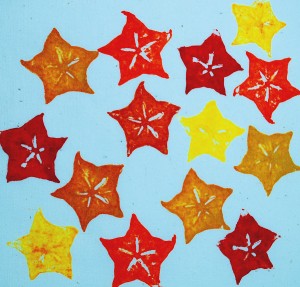
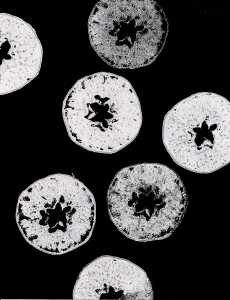
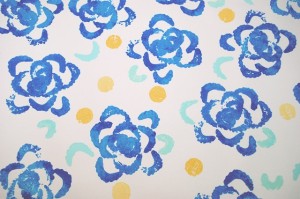
These are not subatomic particles.
The above quote is from Bill Bryson’s book A Short History of Nearly Everything (which is a joy and a half) and this post is concerned with the supreme importance of creativity and endurance. Apparently, Ernest Rutherford’s math skills were not on par for a typical nuclear physicist, and his scientific mind was said to be less than brilliant, but still he managed to excel in his successful career winning many honors and awards including the Nobel Prize in Chemistry in 1908 for his investigations into the disintegration of the elements, and the chemistry of radioactive substances.
Also not subatomic particles.
So how did he manage that? It seems his genius shone in his own brand of creativity.
“According to his longtime colleague James Chadwick, discoverer of the neutron, he wasn’t even particularly clever at experimentation. He was simply tenacious and open-minded. For brilliance he substituted shrewdness and a kind of daring. His mind, in the words of one biographer, was ‘always operating out towards the frontiers, as far as he could see, and that was a great deal further than most other men.’ “
For those of us with strong leanings in the arts (oh, the humanities!) and our reliance on keen, penetrating, creative awareness, we can take a tip from this Nobel Prize winner and be receptive to distant-thinking possibilities, be willing to persevere day after day, night after night as we muddle through in our strive for perfection.
It seems atomic age timing was on Rutherford’s side, too, but it’s good to know that really hard work and a never-give-up attitude can pay off in the end.
No one knows what subatomic particles look like. Maybe they look like this.
Wondering if I create paintings and nature prints just for form’s sake, just for appreciation of the beauty in nature, or do they have another purpose? The representations I create give another kind of life to the world I live in, what I can and can’t see. Creating art is an assertion of my relationship with my surroundings – as I experience and imagine them. This is how I can be at home in the world.
And in creating art we marry the real, sensory experience to something within ourselves that is beyond the senses.
The experience combined with our unexplainable-something is translated onto paper and canvas, into sculpted forms and notes of music, words on a page and dance moves.
Art is life translated.
And in that translation, the art becomes as real as the experience that inspired it.